
WikiLinks - Wikipedia Navigation Game
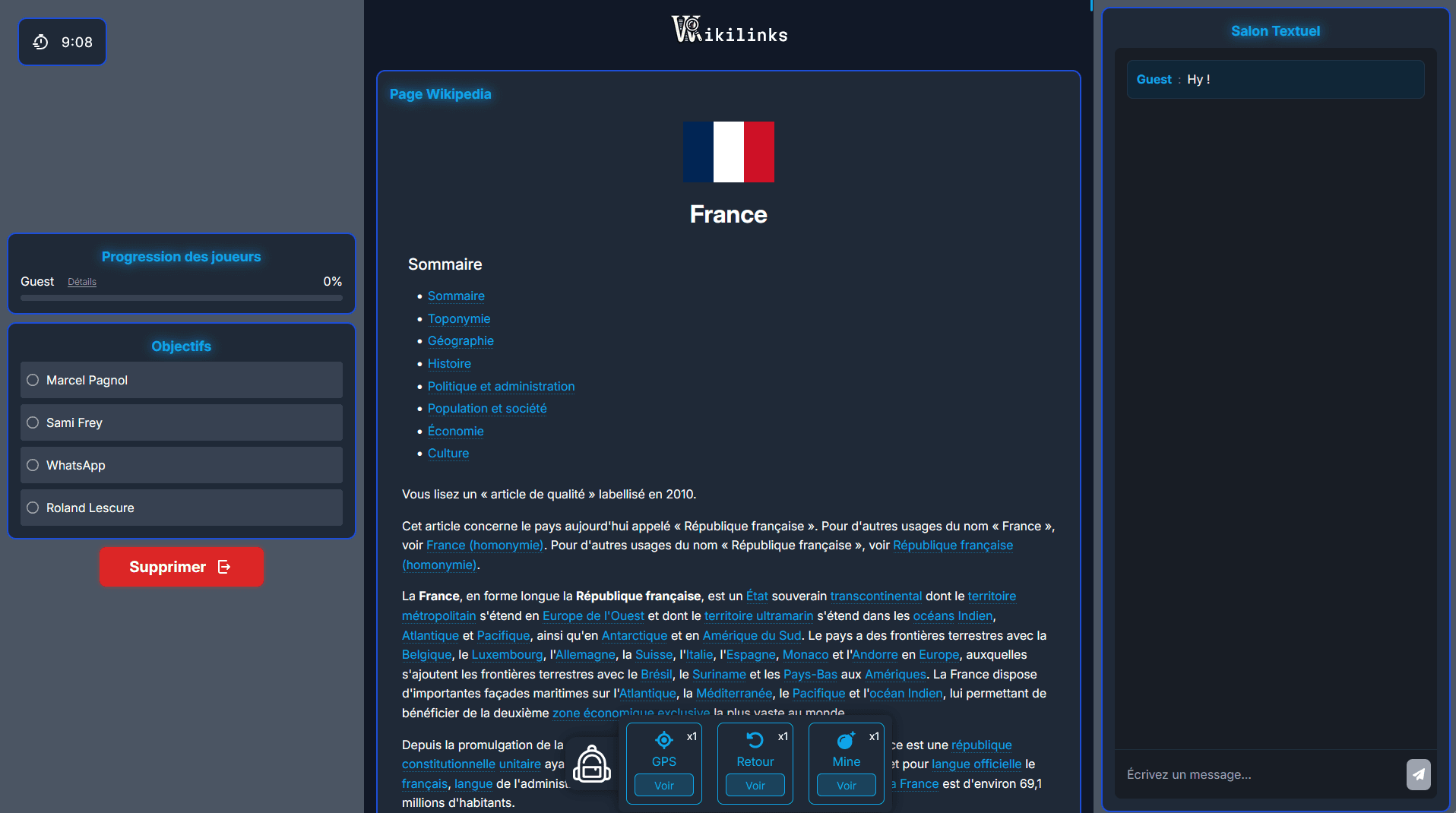
Project Overview
Competitive real-time multiplayer Wikipedia navigation game featuring strategic artifacts, a C-based BFS solver, and a daily challenge mode.
Project Metrics
Key Features
Real-time Multiplayer
WebSocket communication for gameplay, chat, and live tracking of opponent actions
8 Strategic Artifacts
Positive and negative power-up system with inventory and real-time effects
C-based BFS Solver
Shortest-path search over the Wikipedia link graph compiled as a native binary
Daily Challenge
Solo daily game mode with Android geolocation and persistent leaderboard
Technical Skills
Memory Optimization & Serialization
Learned to load and traverse the Wikipedia graph in C under tight memory constraints: binary serialization and compact data structures
Horizontal Scaling with Redis
Set up WebSocket backend replicas with Redis as source of truth: pub/sub, cross-replica command forwarding, heartbeats, and distributed session registry
Full-Stack Containerization
Multi-stage Docker containerization of the full stack: C solver compilation in image, runtime env injection for frontend, Redis AOF persistence, and healthchecks
Team Coordination
Guardian and full-stack developer role in a team of 4: quality assurance, code review, and cross-functional development
Detailed Description
Development of a competitive multiplayer Wikipedia navigation game, built by a team of 4 as part of the semester 4 SAE project in the BUT Computer Science curriculum. Players compete in real time to reach target Wikipedia articles by following internal hyperlinks.
Full-stack architecture featuring a React 18 and TypeScript frontend (Vite, Mantine, Tailwind CSS, Framer Motion) communicating via WebSocket with a Node.js server handling game sessions, real-time chat, and a system of 8 strategic artifacts: GPS, Teleporter, Mine, Backtrack, Snail, Eraser, Disorienter, and Dictator. Shortest-path solver implemented in C (BFS over the Wikipedia link graph) powering the GPS and Teleporter artifacts, requiring significant work on graph serialization and optimization due to the sheer size of the dataset imposing tight constraints on memory loading and traversal. MongoDB database for daily challenge persistence and leaderboard tracking.
Migration to a cloud architecture with multi-stage Docker containerization of the full stack. Backend WebSocket replicas powered by Redis as a distributed source of truth: pub/sub for inter-replica communication, command forwarding for routing actions to the correct instance, heartbeats for detecting failed replicas, and automatic cleanup of orphaned sessions. Native Android application (Java) embedding the web app through a WebView component with geolocation and push notifications.
GitLab CI/CD pipeline with automated deployment. Achieved the highest grade among all groups (17/20).