
GitLab CI/CD Component Catalog
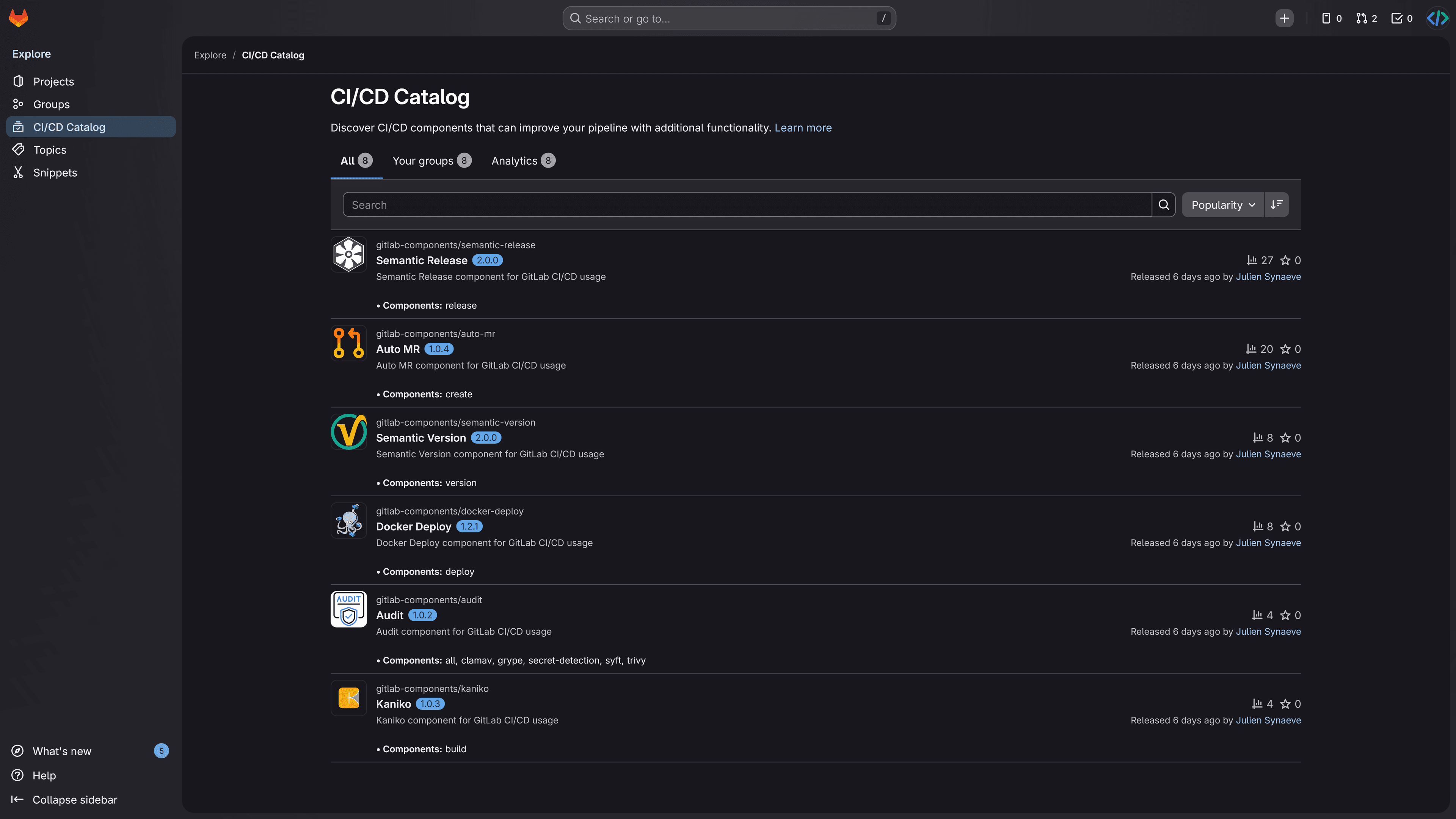
Project Overview
A set of 6 reusable GitLab CI/CD components to industrialize and standardize pipelines: security auditing, semantic versioning, automated releases, Kaniko builds, and Docker deployment with rollback.
Project Metrics
Key Features
Auto Merge Request
Automatic draft merge request creation on the first push of a new branch
Security Audit
5 integrated analysis tools: antivirus, SBOM, vulnerabilities, secrets, and dependencies
Versioning & Release
Semantic version calculation (bump or timestamp) and GitLab release creation based on Conventional Commits
Deployment with Rollback
Docker Compose deployment via SSH with automatic backup and restore on failure
Technical Skills
Reusable Component Design
Learned to design isolated CI components: idempotency, typed inputs, no global side effects, and dynamic job naming to prevent collisions
Software Supply Chain Security
Understood software supply chain security concepts: SBOM generation, vulnerability databases (Grype, Trivy), and secret detection
Production-Grade Bash Scripting
Wrote production-grade shell scripts for CI environments: error handling, ephemeral authentication, and SSH automation
GitLab Technical Research
Researched and synthesized GitLab documentation to establish component writing conventions from the Component Catalog standard introduced in GitLab 17.0
Detailed Description
Design and development of a reusable GitLab CI/CD component catalog, compliant with the Component Catalog standard introduced in GitLab 17.0. Six independent components cover the entire project lifecycle: security auditing (ClamAV, Syft, Grype, Trivy, secret detection), automatic merge request creation, unprivileged Docker image builds via Kaniko, semantic version calculation (bump on main via Conventional Commits, timestamp on feature branches), GitLab release creation via release-cli, and Docker Compose deployment over SSH with automatic rollback.
Each component is configurable through typed inputs, idempotent, and tested via dogfooding in its own repository. The architecture follows strict rules: pre-built images, ephemeral authentication, dynamic job naming to prevent collisions, and no global keywords to avoid interfering with the consumer project's configuration.
Migrating the portfolio's pipeline reduced its .gitlab-ci.yml file from 212 to 90 lines (-57%), while adding previously missing capabilities (full security audit, automatic rollback, auto-MR). The component writing convention was established through in-depth research into GitLab best practices.